Complete Guide to Creating Merdeka Teaching Modules
A comprehensive guide to designing Merdeka Curriculum teaching modules and lesson components.
The Merdeka Curriculum teaching module is a complete lesson planning document that combines lesson plans (RPP), teaching materials, student worksheets, and assessment instruments into one package. Often called "RPP Plus," this document guides teachers in facilitating student-centered learning activities to achieve Learning Outcomes (Capaian Pembelajaran/CP) per phase.
As classroom teachers, we often think preparing teaching materials means piling up thick stacks of paper just for supervision purposes. In reality, the 2025 Revised Learning and Assessment Guide published by the Ministry of Basic and Secondary Education (Kemendikdasmen) confirms there is no strict, binding format for teachers. A valid planning document is one we actually use in the classroom, not just one sitting in a filing cabinet.
Educators have full freedom to choose three paths: create documents from scratch, modify examples available on the Merdeka Mengajar Platform (PMM), or make a concise version containing minimal components. This article breaks down the component structure, the systematic preparation steps based on backward design, and practical examples for elementary and middle school levels.
Merdeka Curriculum Teaching Module Components: Minimal vs. Complete
Before opening your word processor, decide how detailed your document needs to be. Regulations provide a minimal component option for teachers who need daily practicality, and a complete component option for those who want to prepare standalone learning packages to share with colleagues.
Here is a structural comparison between the minimal and complete component formats:
If you are mapping out material for a whole topic for the first time (for example, a 2 to 3-week allocation), compiling the complete format will save a lot of effort. All worksheets, reading materials, and grading rubrics are gathered in one file. You no longer need to look for separate books when the school bell rings.
1. General Information
This section maps out your class context before learning begins. It includes the author's identity, school name, education level, phase, and time allocation. Here we also note prerequisite skills, which are the basic knowledge or skills students must master before learning a new topic.
Do not forget the target students. Our classes are almost always heterogeneous: there are regular students, students with learning difficulties, and high achievers. Noting this condition early reminds us to prepare learning assistance (scaffolding) during the core activities later. For the Pancasila Student Profile, just pick one or two dimensions that you actually practice in class activities, such as Critical Reasoning when analyzing data or Mutual Cooperation when discussing in groups.
2. Core Components
This is the heart of your instructional design. This section opens with Learning Objectives (TP) derived from the Learning Objective Flow (ATP). If you need to refresh your memory on how to break down CP into TP, please read the complete Guide to Merdeka Curriculum Learning Outcomes Breakdown we published previously.
Aside from objectives, the core components contain meaningful understanding (big ideas) that explain the material's real life benefits for students, and trigger questions to spark curiosity. After that, we write down the learning activity sequence (introduction, core, closing), the assessment design along with the Learning Objective Achievement Criteria (KKTP), and reflection sheets for teachers and students.
3. Attachments
The attachments act as your teaching logistics warehouse. Student Worksheets (LKPD) go here along with reading materials for teachers and students, adjusted to the class reading level. Also include enrichment guides for students who exceed targets faster, remedial programs for re-assistance, a glossary of technical terms, and a bibliography.
Backward Design Paradigm (UbD) in Planning
Why do many lesson plans feel bland when put into practice? Grant Wiggins and Jay McTighe in their book Understanding by Design highlight two classic educator mistakes when designing learning: coverage-oriented teaching focused on finishing textbook pages, and activity-oriented teaching that simply seeks fun activities without clear competency direction.
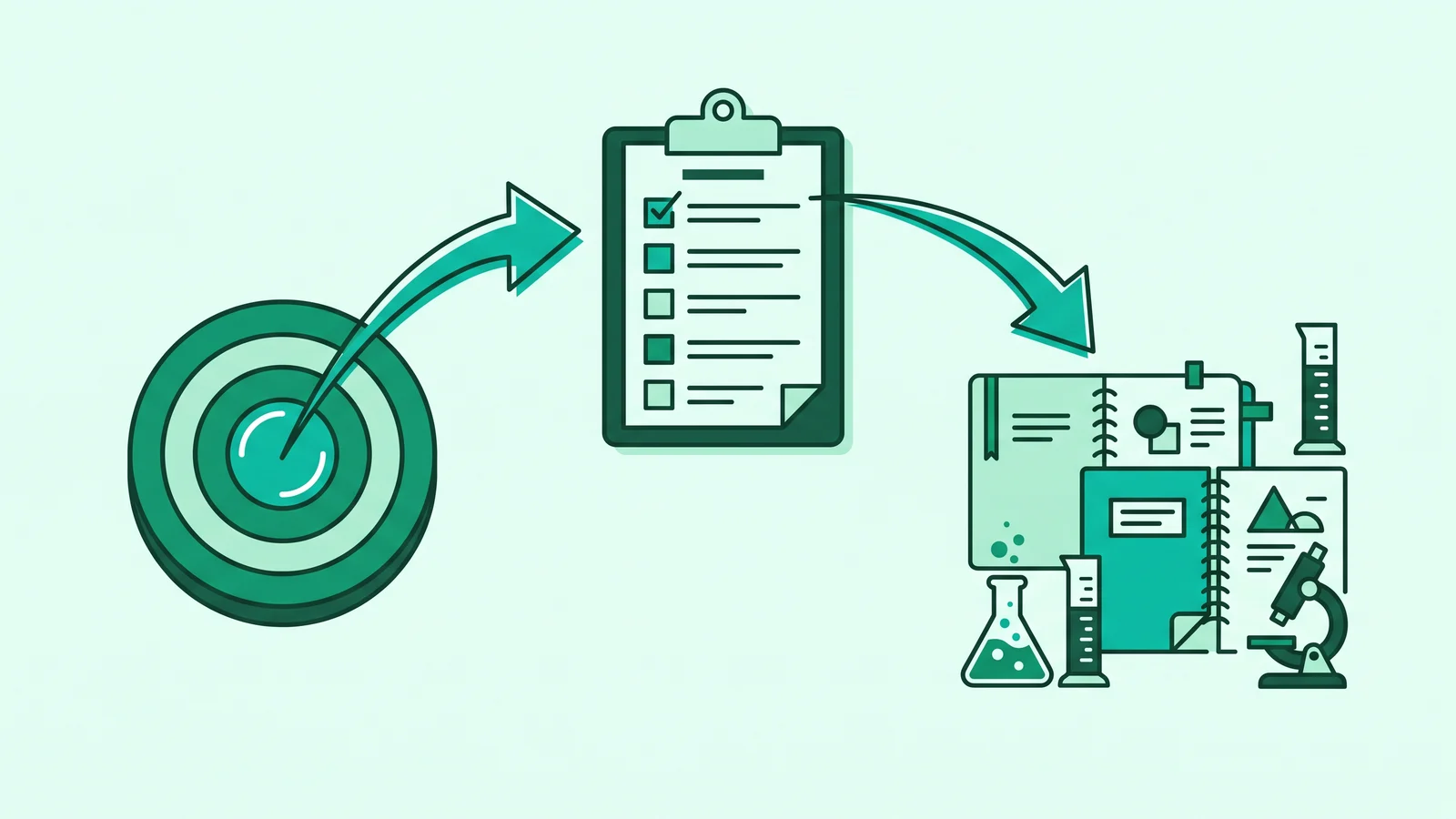
To avoid these two traps, compiling a Merdeka Curriculum teaching module adopts the Backward Design framework. We do not start by asking "What craft should the kids make tomorrow?" Instead, we move backward through three logical stages: setting the final goal → designing assessment evidence → planning learning activities.
Stage 1: Determine Desired Results (Learning Objectives)
The first step is to establish the competencies and material scope that students must master after the lesson series ends. As explained in the Visual Arts Teacher Guide for Elementary Grade 2 Revised Edition, Learning Objectives are derived directly from the CP elements by separating operational verbs (competency) and main concepts (material scope).
Use the ABCD formulation (Audience, Behavior, Condition, Degree) so the objectives are concrete and measurable in class:
- Condition: Through observing plants in the school yard...
- Audience: ...4th grade students...
- Behavior: ...can identify plant body parts and their functions...
- Degree: ...by accurately arranging a labeled diagram with at least 4 parts.
Stage 2: Determine Evidence of Achievement (Assessment and KKTP)
Before planning class activity scenarios, first determine the evidence: how do we know students have achieved the goals in Stage 1? This is where we design diagnostic, formative, and summative assessment instruments, as well as the Learning Objective Achievement Criteria (KKTP).
In the 2025 Revised Learning and Assessment Guide, teachers are encouraged not to stick to just one taxonomy. Aside from Anderson and Krathwohl's revised Bloom's Taxonomy (C1 to C6) or Marzano's Taxonomy, we can explore the Six Facets of Understanding (explanation, interpretation, application, perspective, empathy, and self-knowledge) and the SOLO Taxonomy (Structure of the Observed Learning Outcome) by John B. Biggs and Kevin F. Collis.
The SOLO Taxonomy is very practical for compiling KKTP rubrics because it captures the quality of student answers in stages from shallow to deep:
- Prestructural: Students do not understand the concept at all and provide irrelevant responses.
- Unistructural: Students can only mention one plant part without knowing its function.
- Multistructural: Students mention several plant parts and their functions, but they remain separate as a list of facts.
- Relational: Students can connect how roots absorb water from the soil then send it to the leaves to be processed in photosynthesis.
- Extended Abstract: Students can draw generalizations and predict what happens to the surrounding ecosystem if the plant's organ functions are damaged by pollution.
Stage 3: Plan Learning Experiences and Differentiation
Once the objectives and measurement tools are ready, we then arrange the learning activity sequence from introduction, core, to closing. Pick a learning model that requires students to actively build their own understanding, such as Problem Based Learning (PBL), Project Based Learning (PjBL), or Discovery Learning. You can see a step comparison of all three in this review of Types of Innovative Learning Models and Syntax.
In this third stage, we also insert realistic differentiated learning based on class conditions:
- Content Differentiation: Providing short illustrated narrative texts for students still at the basic reading stage, and visual infographics or short videos for students who need varied media stimulation.
- Process Differentiation: Dividing the amount of guidance (scaffolding). Independent groups receive hint cards to discuss on their own, while the teacher sits with groups still struggling to understand instructions.
- Product Differentiation: Letting students show evidence of their understanding through various formats that meet the same competency demands, whether it is a wall poster, a mind map, or a voice recording and oral presentation.
Practical Tip for Trigger Questions: Do not use memorization test questions as triggers at the start of class. Avoid asking, "What is the definition of an ecosystem?" Replace it with a dilemma question that provokes curiosity: "What would happen to the rice fields in our village if the entire frog population suddenly died out tonight?"
Teaching Module Application Based on Phase and Level
The Merdeka Curriculum groups learning outcomes based on a child's developmental phase, not just annual grade promotions. Therefore, a Merdeka Curriculum elementary teaching module design requires a different psychological approach and media selection compared to the middle school level.
Let us look at how to differentiate activity scenarios between Phase B in elementary school and Phase D in middle school.
1. Elementary Level Phase B (Grades 3 and 4)
Grade 3 and grade 4 students are under the same Phase B umbrella. Even though they share a phase, it does not mean their planning documents are identical. The Learning Objective Flow (ATP) divides material depth continuously over two years: grade 3 focuses on concrete concept foundations in the immediate environment, while grade 4 starts shifting to analytical exploration.
When designing activities for grade 3, for instance in Mathematics on simple fractions, students still rely heavily on concrete objects. The activity scenario must involve manipulative media like folding origami paper, cutting fruit, or coloring flat shape blocks. The teacher guides students to discover the concepts of a half (1 ÷ 2) and a quarter (1 ÷ 4) themselves through Discovery Learning and Inquiry Stages for Class activities before introducing the number symbols on the board.
The situation is different when we compile grade 4 teaching materials for Science and Social Studies (IPAS) on states of matter and their changes. Grade 4 students are ready for simple classroom experiments. The attached interactive LKPD no longer just matches pictures, but contains a structured observation table. Students observe heated butter or ice cubes, record their state changes, then discuss why water droplets appear on the glass lid.
2. Middle School Level Phase D (Grades 7, 8, and 9)
Entering middle school (Phase D), adolescent cognitive structures shift toward abstract reasoning, critical thinking, and contextual problem solving. At this level, learning activities are no longer effective if they only contain one-way lectures and assignments summarizing textbooks.
For example, in grade 7 and 8 Science or Indonesian Language subjects about school waste management, applying Project Based Learning (PjBL) across multiple meetings is highly appropriate. A single teaching module document can be designed for a 3-meeting allocation (e.g., 6 to 9 lesson hours):
- First Meeting: Students observe waste accumulation spots in the school environment, interview janitors, and formulate the main problem.
- Second Meeting: Students process waste composition data, find scientific references in the library, then design a solution prototype or draft an observation report text.
- Third Meeting: Each group presents their findings and solution campaign in front of the class, followed by a peer assessment session.
Assessment rubrics in middle school modules are also arranged multidimensionally. The teacher does not just score the final conclusion right or wrong, but evaluates field data accuracy, logical argument structure flow, and report language rule correctness using the SOLO Taxonomy levels.
4 Common Mistakes When Compiling Teaching Modules and Their Solutions
Many teachers experience administrative fatigue due to misunderstanding the essence of planning in the Merdeka Curriculum. This mistake makes the thickly printed documents lose their function the moment the teacher steps into the classroom.
Avoid the Copy-Paste Syndrome Trap: Downloading teaching modules from the internet and printing them immediately just by changing the school name and principal's signature is a fatal mistake. Teaching materials that work in a fully equipped school will not necessarily run smoothly in a class with limited teaching aids. Always conduct a simple initial assessment, then modify the time allocation, media, and task difficulty levels to match your students' conditions.
Here are four other design mistakes along with their corrective steps:
- Making Three Different Modules for One Class: Many educators think differentiated learning requires creating three separate documents for advanced, average, and slow student groups. This method drains time and energy. The solution is to compile just one teaching module with the same Learning Objectives, but include tiered assignments or varied assistance (scaffolding) in the core activity steps.
- Assessments Not Aligned with Objectives (Misalignment): The Learning Objective states students can analyze relationships between living things (relational reasoning/C4), but the formative assessment instrument only contains multiple choice questions memorizing definitions (C1). Ensure the operational verbs in the objectives align with the evidence demands in the assessment rubric.
- Including All Pancasila Student Profile Dimensions: Listing all six dimensions at once in one module makes character building focus blurry and hard to observe. Pick just 1 to 2 dimensions most relevant to the learning activities on that topic.
- Ignoring the Student Reflection Stage: Because teachers are busy chasing material completion, lessons often end without tying everything together. Actually, the 2025 Revised Learning and Assessment Guide emphasizes that student reflection is an integral part of building independence, critical thinking skills, and a culture of transparency in class. Set aside 5 to 10 minutes in the closing activity to hand out exit tickets or do a 3-2-1 reflection (3 new things learned, 2 interesting things, 1 remaining question).
Frequently Asked Questions (FAQ)
No, they are not. Educators have the right to choose between compiling their own teaching module, directly using modules provided by the government on the Merdeka Mengajar Platform (PMM), or modifying existing modules to align with student characteristics and school conditions.
A 1-page lesson plan only concisely contains three essential components (objectives, activity steps, and assessment) as a reminder guide for teachers. A teaching module contains more complete and operational components because it includes in-depth activity guides, student worksheets, reading materials for teachers and students, and detailed assessment rubrics.
Yes, they still differ in material depth and competency staging. Even though they share the same Phase B Learning Outcomes, the Learning Objective Flow (ATP) is arranged sequentially: grade 3 studies the foundation of concrete early concepts, while grade 4 expands and deepens the advanced competencies.
Teaching modules are generally arranged per learning topic unit or per Learning Objective, not per single daily lesson hour. One teaching module document is on average designed to complete one subtopic entirely within a span of 1 to 3 meetings (about 1 to 3 weeks of learning).