Guide to Merdeka Curriculum Learning Outcomes Breakdown
A practical guide to breaking down Merdeka Curriculum learning outcomes into effective lesson plans.
Merdeka Curriculum Learning Outcomes (CP) represent the minimum competencies students must achieve in each developmental phase, from the Foundation Phase (early childhood education) to Phase F (senior high and vocational schools). The government sets these outcomes in complete narrative paragraphs that combine knowledge, skills, and attitudes. Teachers then break these down into Learning Objectives (TP) and organize them systematically into a Learning Objective Flow (ATP).
Many teachers still treat the CP documents like the Core Competencies and Basic Competencies from the older 2013 Curriculum. As a result, breaking down these outcomes turns into an exhausting administrative task. They split paragraphs into dozens of micro-indicators and rush to complete the semester's material.
However, the core spirit behind the evolution of Indonesia's curriculum toward the Merdeka Curriculum is flexibility and conceptual depth. As classroom practitioners, we need to shift our perspective from simply finishing the textbook to making sure students truly understand the material.
Understanding the Structure and Regulations of Merdeka Curriculum Learning Outcomes
The government established the Merdeka Curriculum as the national curriculum for early childhood, primary, and secondary education through Permendikbudristek No. 12 of 2024. Meanwhile, the official reference for the CP text we use in schools follows the Head of BSKAP Decree No. 032/H/KR/2024, which officially revoked the previous regulation (BSKAP Decree No. 033/H/KR/2022).
Entering the 2025/2026 academic year, the Ministry of Primary and Secondary Education (Kemendikdasmen) strengthened the pedagogical direction in classrooms through a Deep Learning approach. This approach rests on three main pillars:
- Mindful Learning: Full awareness and active student involvement in the thinking process.
- Meaningful Learning: Connecting academic concepts with real everyday problems.
- Joyful Learning: A learning atmosphere that sparks curiosity and the joy of thinking, rather than just noisy play without substance.
The implication is very clear when we analyze the Merdeka Curriculum Learning Outcomes: formulating Learning Objectives can no longer just chase surface-level memorization. The government intentionally wrote the CP text in narrative paragraphs so teachers view student competencies in a complete and holistic way.
Developmental Phase Distribution
The Merdeka Curriculum does not tie achievement targets to grade levels, but rather to phases. This phase division gives teachers room to apply instruction that matches the students' achievement levels (Teaching at the Right Level):
- Foundation Phase: Early Childhood Education (Kindergarten, Playgroups, or similar units).
- Phase A: Grades 1 and 2 Primary School.
- Phase B: Grades 3 and 4 Primary School.
- Phase C: Grades 5 and 6 Primary School.
- Phase D: Grades 7, 8, and 9 Junior High School.
- Phase E: Grade 10 Senior High/Vocational School.
- Phase F: Grades 11 and 12 Senior High/Vocational School.
Because Learning Outcomes are designed per phase (usually spanning 2 to 3 years), Grade 1 and Grade 2 teachers in Phase A, or Grade 7, 8, and 9 teachers in Phase D, must sit together. You cannot create a Learning Objective Flow alone without agreeing on the scope of material with your colleagues in the same phase.
The Relationship Between CP, TP, and ATP in Backward Design
Before getting into the technicalities of mapping sentences, we need to align our understanding of three key terms in the Learning and Assessment Guide (PPA):
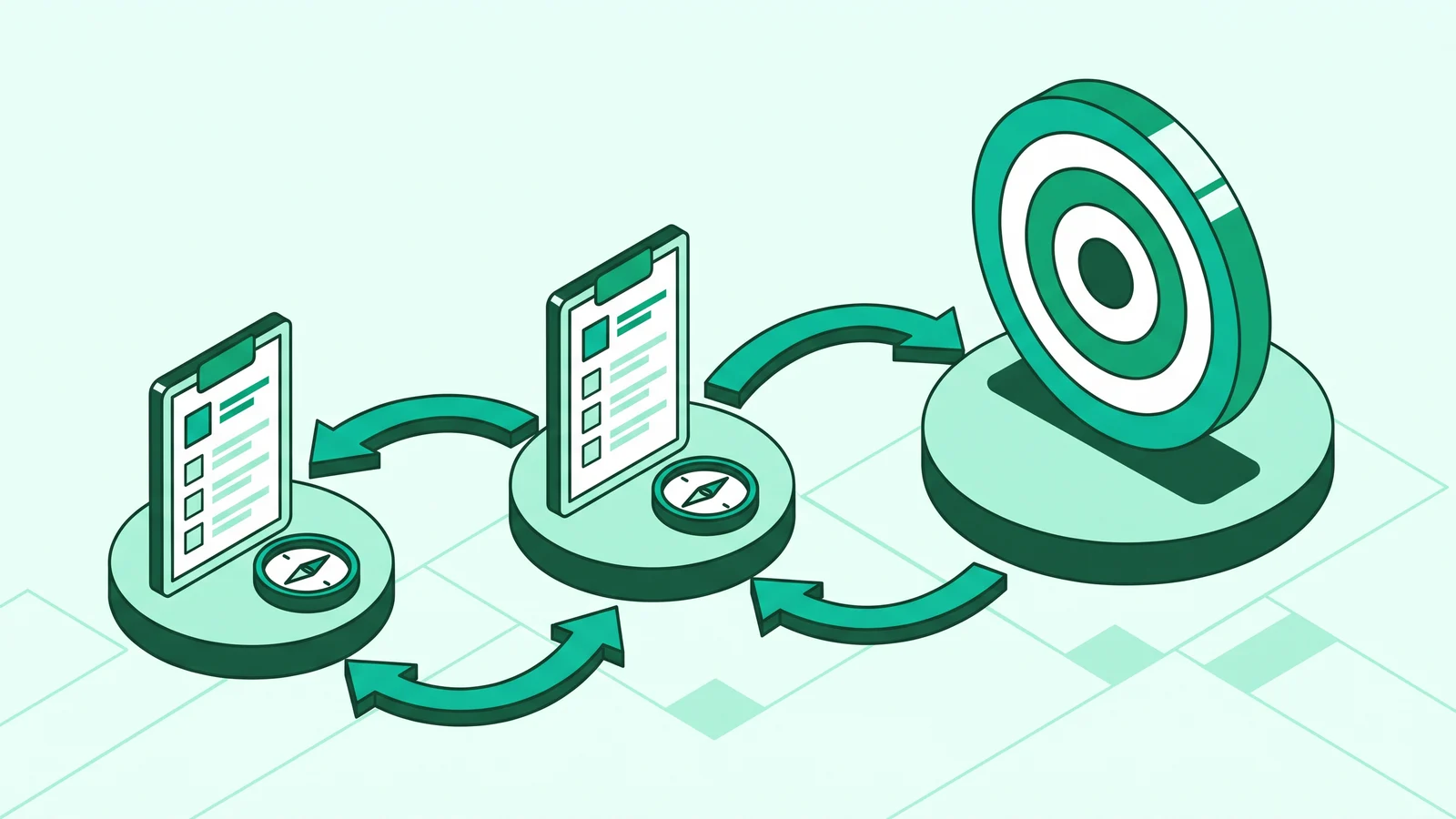
- Learning Outcomes (CP): The end-of-phase competency targets set by the central government. The wording is standardized and teachers cannot change it.
- Learning Objectives (TP): A description of the achievement of three competency aspects (knowledge, skills, and attitudes) that students need to build in one or more learning activities.
- Learning Objective Flow (ATP): A series of Learning Objectives arranged chronologically, logically, and systematically from the beginning to the end of a phase. The ATP functions similarly to a syllabus in previous curricula: it serves as a learning navigation map.
A common mistake in Teacher Working Groups (KKG) or Subject Teacher Forums (MGMP) is jumping straight from the CP text to creating teaching materials. Effective curriculum design actually uses Backward Design (Understanding by Design by Wiggins and McTighe).
When you break down Learning Outcomes into Learning Objectives, ask yourself directly: "If students successfully achieve this objective, what performance evidence or authentic assessment must they show?" Setting assessment evidence right from the objective formulation stage will keep us from the temptation of creating abstract, hard-to-measure learning goals.
Also, filter the subject matter through the lens of Deep Learning. Be brave enough to sort out which information is just "worth being familiar with" and which core concepts require "enduring understanding". Streamlining the material prevents Learning Objectives from artificially overloading students' cognitive capacity.
Practical Steps to Break Down CP into Learning Objectives (TP)
Every healthy Learning Objective formulation must contain two essential components: Competency and Scope of Material.
- Competency is a concrete ability or skill that students can demonstrate. Action verbs or forms of deep understanding represent this component.
- Scope of Material is the content, main concept, or core information that students need to learn in a teaching unit.
The Learning and Assessment Guide provides three alternatives for educators to formulate Learning Objectives from the Merdeka Curriculum Learning Outcomes text:
- Alternative 1 (Formulating TP directly from CP): Teachers dissect the CP paragraph directly to mark competency verbs and key materials, then arrange them into a TP sentence.
- Alternative 2 (Formulating TP by analyzing CP elements): Teachers review the achievement description in each subject element one by one, map out the competencies and essential materials in each element, and then string them into a TP.
- Alternative 3 (Formulating cross-element TP): Teachers combine competencies from two or more CP elements into one unified TP. This third method works perfectly for subjects like Natural and Social Sciences (IPAS), Indonesian Language, or when designing project-based innovative learning models.
We can apply this mapping process gradually in schools.
Prepare the Official Document BSKAP Decree 032/H/KR/2024
Open the CP document for the subject and phase you teach. Focus your attention on the achievement table per element, not just the general achievement paragraph, so you do not miss process skill details.
Highlight Competency Verbs and Core Concepts
Use two highlighter colors or a two-column table. Separate the verbs showing student actions (e.g., identify, compare, design, present) from the nouns showing material concepts (e.g., changes in states of matter, ecosystems, place value).
Combine Them Into a Complete and Flexible TP Sentence
Combine the competency and scope of material into an operational TP sentence. Make sure the TP sentence is flexible enough to support differentiated learning, allowing students with different learning readiness to reach the same goal through adjusted task complexity (tiered assignments).
Determine Assessment Indicators for Each TP
Write one short sentence next to the TP regarding its proof of achievement. This step ensures the TP you create is truly observable in the classroom.
You do not have to stick strictly to the Operational Verbs (KKO) of Anderson and Krathwohl's revised Bloom's Taxonomy (C1 to C6). The Ministry's PPA document officially recognizes other, more flexible theoretical frameworks for deep learning, such as the Six Facets of Understanding by Wiggins and McTighe (explain, interpret, apply, have perspective, empathize, have self-knowledge) or Marzano's Taxonomy.
Case Studies: Mapping CP to TP in Early Childhood and Junior High Schools
To ensure the concepts above do not just remain theories on paper, we can analyze two concrete examples from different education levels: Early Childhood Learning Outcomes (Foundation Phase) and Phase D Learning Outcomes for Junior High School.
1. Early Childhood Case Study (Foundation Phase)
In the Fundamentals of Literacy, Mathematics, Science, Technology, Engineering, and Art element, there is the following CP sentence snippet:
"Children recognize and use pre-mathematics concepts to solve problems in everyday life."
If we break it down using a component analysis table, the results look like this:
- Competency: Recognize, use concepts to solve problems.
- Scope of Material: Pre-mathematics concepts in everyday life (object classification, patterns, simple cause-and-effect relationships).
From this mapping, an early childhood educator can formulate concrete Learning Objectives that fit the child's world of play:
- TP 1: Children can group objects in their surroundings based on similar color, shape, or size.
- TP 2: Children can recognize and continue simple repeating patterns (like A-B-A-B patterns) through stringing beads, stacking blocks, or rhythmic movements.
- TP 3: Children can compare quantities of objects (more, less, or equal) when sharing toys or food with friends.
2. Junior High School Case Study (Phase D Science Subject)
Look at a snippet of the Phase D CP text for Natural Sciences (IPA), specifically in the Science Understanding Element:
"Students can identify the properties and characteristics of matter, distinguish physical and chemical changes, and separate simple mixtures."
The two core components separate as follows:
- Competency: Identify, distinguish, separate (perform separation).
- Scope of Material: Properties and characteristics of matter, physical and chemical changes, simple mixtures.
The Learning Objective formulations supporting Deep Learning and scientific inquiry are:
- TP 1.1: Identify the physical and chemical properties of a substance by observing concrete phenomena in the everyday environment.
- TP 1.2: Distinguish the characteristics of physical and chemical changes based on data analysis from simple experiments.
- TP 1.3: Design and practice simple mixture separation methods (such as filtration and evaporation) to solve water cleanliness problems in the surrounding environment.
Notice how TP 1.3 above instantly clears the path for teachers to apply Problem Based Learning (PBL) in the laboratory or outside the classroom. Students do not just memorize the definition of filtration; they use it to solve real problems.
How to Organize a Logical Learning Objective Flow (ATP)
After mapping all the TPs in one phase, the next task is arranging these pieces into a continuous flow line from the beginning to the end of the phase. This sequence is what we call the Learning Objective Flow (ATP).
How do you determine which TP to teach in the odd semester of grade 7, which in grade 8, and which in grade 9? Do not sort them based solely on the chapter order in printed textbooks. Use one or a combination of the following five logical sequencing approaches:
- Concrete to Abstract Sequencing: Learning starts by observing real objects close to the students' senses, then moves toward theoretical or symbolic concepts. For example, in primary school math: manipulating concrete objects first before introducing area formulas for flat shapes.
- Deductive Sequencing: Learning opens with an explanation of general concepts or principles, then students apply those principles to specific cases.
- Easy to Difficult Sequencing (Scaffolding): Teachers arrange TPs from the simplest skills to complex problem-solving. The teacher provides learning support gradually and reduces it as students become more independent.
- Hierarchical Sequencing: This approach requires mastering prerequisite competencies before students move to the next competency. You cannot teach mixed fraction operations if students have not mastered the basic concepts of integer division and multiplication.
- Procedural Sequencing: Teachers arrange TPs following standard work process stages from start to finish. For example, in computer science or language classes: starting from planning an outline → drafting → editing → publishing the work.
After arranging the TP sequence neatly, distribute them into the grades within that phase and include the estimated Lesson Hours (JP) allocation based on your school's academic calendar.
Common Mistakes When Analyzing CP and How to Avoid Them
Many educators still fall into recurring error patterns when designing teaching materials. The table below summarizes four main traps when processing Merdeka Curriculum Learning Outcomes along with their corrective steps.
Avoid downloading ATP documents from the internet and immediately changing the school name and principal's signature without reading the contents. If a school supervisor or assessor asks why a certain TP is placed at the beginning of the semester when your students have not mastered the prerequisite material, that copied document will only cause you trouble in the classroom.
For those who want to design an agile learning atmosphere after organizing the ATP, you can combine the objective flow with the Accelerated Learning in Merdeka Curriculum approach to make classroom time more effective without sacrificing conceptual depth.
Frequently Asked Questions (FAQ)
No. The Learning Outcomes text is a national competency standard set through official government regulations (Head of BSKAP Decree No. 032/H/KR/2024). Full autonomy and freedom for teachers lie in translating the CP into Learning Objectives (TP), arranging the ATP sequence, and designing Teaching Modules according to the educational unit's context.
There is no single mandatory format. Schools and teachers are free to organize ATP documents as matrix tables, numbered lists, or visual flowcharts. The main principle is that the document contains a logical sequence of Learning Objectives from the beginning to the end of the phase, grade distribution, and estimated Lesson Hours (JP) allocation.
The government does not limit the number of TPs to an absolute number. However, to keep learning deep and avoid breaking it into exhausting micro-indicators, subjects with an allocation of 2 to 3 Lesson Hours per week generally have around 8 to 15 essential TPs in one full phase.
Absolutely. The Merdeka Curriculum is designed as a flexible and living curriculum. If mid-semester formative assessment results show that the majority of students have not mastered prerequisite concepts, teachers have the right to readjust the sequence or time allocation within the ATP.