7 Accelerated Learning Methods: Fast & Effective
Discover evidence-based accelerated learning techniques to absorb complex concepts efficiently.
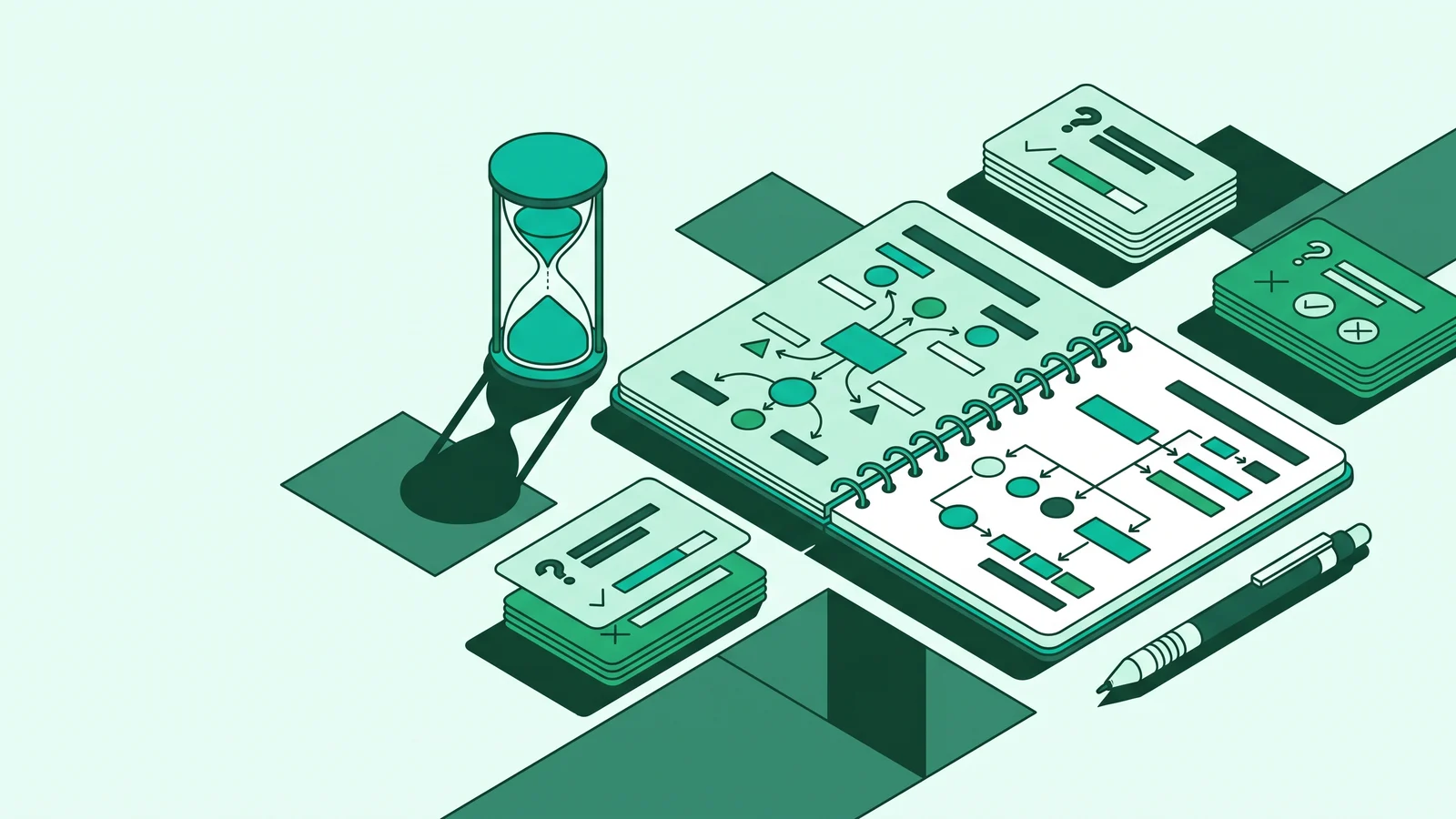
Accelerated learning is an approach based on brain science and cognitive psychology that helps students and self-directed learners absorb, process, and retain essential concepts quickly without sacrificing depth. This method replaces passive memorization with multisensory stimulation, active recall, and structured spaced repetition.
Many educators and students still mistake this concept for speed reading or cramming. Rushing to pack in information only piles on cognitive overload in short-term memory. As soon as the exam ends, that information vanishes.
Whether in a classroom or during self-study for design and programming, the biggest barrier to learning is rarely a lack of talent. The main problem is using study methods that fight the biological architecture of the human brain. This article covers the scientific foundation, compares different methods, and breaks down seven accelerated learning techniques with real examples you can use today.
Why Accelerated Learning Changes How We Study
A large meta-analysis led by John Dunlosky (2013) from the Association for Psychological Science evaluated ten popular study techniques. The results surprised many teachers and students. The most common study habits, such as re-reading textbooks, highlighting sentences, and writing passive summaries, proved highly ineffective.
On the other hand, accelerated learning relies on high-utility techniques that force the brain to actively wire new synaptic connections. If you look at the history of accelerated learning, this approach is designed to align analytical functions with visual imagination and physical engagement.
Modern education paradigms emphasize three main elements: mindful, meaningful, and joyful experiences. When the learning environment is free from pressure and threats, the amygdala does not trigger a stress response. The prefrontal cortex can then absorb and process abstract concepts much faster.
Conventional Studying vs Accelerated Learning Methods
To understand the difference between outdated study habits and accelerated learning, look at the comparison of cognitive and instructional parameters in the following table:
Dave Meier, in The Accelerated Learning Handbook (2000), notes that an ideal classroom follows an 80:20 ratio. This means 80 percent of the time goes to active engagement and learner performance, while the instructor's lecture takes up just 20 percent.
7 Accelerated Learning Techniques and Practical Examples
Understanding cognitive theory will not change your learning results without real execution. Whether you are a teacher planning classroom activities or a professional learning a new skill, here are seven scientifically backed accelerated learning techniques along with examples of how to apply them.
1. Multisensory Integration via the SAVI Approach
The human brain is not built to absorb information from silent text for hours. Dave Meier formulated the SAVI approach to ensure all sensory channels stay active:
- Somatic: Learning by moving, touching, doing physical demonstrations, or manipulating real objects.
- Auditory: Learning through voice intonation, open discussions, debates, and explaining things out loud.
- Visual: Learning by observing diagrams, concept maps, colors, icons, and real demonstrations.
- Intellectual: Learning by pondering problems, analyzing logic patterns, and drawing independent conclusions.
Real application: When teaching fractions in elementary school, do not just write formulas on the board. Ask students to physically cut origami paper (somatic), draw the fraction parts with colored markers (visual), discuss why the pieces have equal value with a peer (auditory), and solve a food-sharing puzzle in a story context (intellectual).
2. Active Recall
Rereading material multiple times often creates a psychological trap called the illusion of competence. You feel you have mastered the material because the sentences look familiar, but your brain only recognizes the text patterns without being able to reproduce the actual ideas.
Active recall, or practice testing, reverses this process. Instead of constantly pushing information into your head, you force your brain to pull information out without looking at the source. The mental effort of trying to remember is exactly what strengthens your neural memory pathways.
Real application: After reading a chapter or watching a 15 minute tutorial video, close your book and turn off your screen. Grab a blank piece of paper and do a brain dump. Write down all the key points, formulas, or concepts you can remember. Once finished, open your book again and use a different colored pen to mark what you missed.
3. Spaced Repetition
Psychologist Hermann Ebbinghaus mapped the Forgetting Curve, proving that humans lose most new memories within days unless that memory is interrupted by scheduled repetition.
Spaced repetition fights the forgetting curve by scheduling material reviews right when your brain is about to forget it. Splitting your study sessions into 25 minutes a day for four consecutive days gives you much stronger memory retention than studying four hours straight in one night.
Real application: Use a tiered interval schedule like 1-3-7-21. If you study foreign language vocabulary or new programming syntax on Monday (Day 1), test your memory again on Wednesday (Day 3), next Monday (Day 7), and three weeks later (Day 21). You can automate this schedule using digital flashcards in apps like Anki or Quizlet.
4. The Feynman Technique
The basic principle of the Feynman Technique is clear: if you cannot explain a complex concept in simple language without hiding behind technical terms, you do not truly understand it.
This technique works as an understanding gap detector. When you simplify concepts like Thermodynamics or Vygotsky's Cognitive Theory for a layperson, you force your brain to build analogies and piece together basic cause and effect relationships.
Real application: Pick a topic you are studying, such as photosynthesis or how a web server works. Stand in front of a mirror or record your voice on your phone, then explain the topic as if your audience is a 10 year old. As soon as you stumble or resort to stiff textbook jargon, stop the recording. That stuck point is the exact part you must study again from the basics.
5. Dual Coding
Based on the Dual Coding theory developed by Allan Paivio, the human brain processes visual information (pictures) and verbal information (words) through two separate cognitive channels. Combining both doubles your memory capacity.
When you pair text explanations with relevant visual representations, you create two memory traces at once. If your brain struggles to recall the verbal definition later, the visual memory will trigger the concept. For educators, this technique relates closely to understanding the differences between learning models, strategies, methods, and techniques so visual media serves a clear purpose rather than just sitting passively in a lesson module.
Real application: Avoid taking linear notes from top to bottom like transcribing a lecture. Split your notebook into two columns. The left column contains brief explanations of a business cycle or science process, while the right column translates that text into a visual format: a flowchart, a 2x2 comparison matrix, or an infographic sketchnote.
6. Interleaving (Mixed Practice)
Most traditional curricula use blocked practice, which means studying a single topic repeatedly for hours until mastered before moving to the next. This pattern feels easy during practice but makes the brain passive because you already know which formula to use from the very first question.
Interleaving is the technique of mixing two to three different but related subtopics in the same study session. While it feels more challenging at first, this method trains your brain to identify problems critically and select the right formula or strategy.
Real application: When studying math or science, do not practice just one type of problem all night. Shuffle practice questions covering integrals, differentials, and matrices in one session. The same goes for UI design: allocate 30 minutes to break down typography hierarchy, 30 minutes for color contrast, and the final 30 minutes to combine both into a complete component.
7. Just-in-Time Scaffolding
This seventh technique targets teachers and classroom instructors. Research by The New Teacher Project (TNTP, 2021) and HMH (2022) shows that traditional remediation approaches, which repeat basic lower-grade materials from scratch, actually cause students to fall further behind.
The accelerated learning solution at the classroom level is to keep materials at the appropriate grade level while providing just-in-time scaffolding (help exactly when needed). This acceleration approach is proven to advance student learning outcomes 1.5 to 2 times faster. For a more detailed guide for schools, you can read 5 ways to apply accelerated learning in Merdeka Curriculum.
Real application: Fifth-grade students are learning to calculate the volume of a rectangular prism, but some students still struggle with long multiplication from previous grades. Do not delay the volume lesson to repeat multiplication from the start. Continue teaching the volume concept to the whole class, then provide a cheat sheet, glossary, or quick step-by-step guide right at the point where the student hits a roadblock.
Practical Steps to Design Daily Accelerated Study Sessions
Having a long list of techniques often leaves beginners wondering where to start. To move past theory, combine the techniques above into a 45 minute daily study cycle using the following steps:
Phase 1: Mental and Environmental Preparation (5 Minutes)
Clear your study desk of unnecessary gadgets and turn off message notifications. Build a mindful state by taking deep breaths to lower tension, then set a specific micro-goal, like "Understand three differences between animal and plant cells".
Phase 2: Multisensory Exploration and Dual Coding (15 Minutes)
Study new material by engaging more than one sense. Read the text while speaking the key points slowly, then immediately turn the paragraph you just read into a concept map, flowchart, or visual sketch on paper.
Phase 3: Active Recall and Feynman Practice (15 Minutes)
Close all your reference books and notes. Grab a blank piece of paper, rewrite the newly learned concepts purely from memory, and explain them out loud in simple language as if teaching a 10 year old.
Phase 4: Gap Review and Rescheduling (10 Minutes)
Reopen your original material and check your active recall results. Mark the parts you got wrong or forgot, restudy those gaps, and put the difficult points into your spaced repetition schedule to test again on Day 3 and Day 7.
Common Traps That Hinder the Accelerated Learning Process
Many learners feel they have applied various fast learning methods, yet their mastery remains stagnant. Evaluate your routine and make sure you are not falling into these four common mistakes:
- Confusing Accelerated Learning with Cramming: Forcing your brain to memorize an entire chapter in one night only holds information in working memory. Without spaced repetition, that information will disappear in 48 hours.
- Falling for the Single Learning Style Myth (Static VAK): Many limit themselves by thinking they are "strictly a visual learner," refusing audio discussions or physical practice. Modern science shows rigid learning styles are a neuromyth; the fastest information absorption happens when all senses combine through the SAVI method.
- Ignoring the Affective Filter: Studying while anxious, afraid of punishment, or under high pressure triggers excess cortisol production, which impairs hippocampus function. Make sure study sessions always begin in a state of relaxed alertness and a psychologically safe environment.
- Falling for the Illusion of Speed (Fast Input Without Reflection): Learning fast does not mean thinking carelessly just to finish a book quickly. Use the techniques above to speed up basic data retrieval, but always allocate time for slow reflective synthesis to connect new concepts with existing knowledge.
Never rely on rereading as a measure of exam readiness. The familiar feeling you get when looking at highlighted notes often tricks your brain. Always test your understanding by closing the book and doing mixed practice questions (interleaving) before declaring a topic complete.
Frequently Asked Questions (FAQ)
Yes. Because accelerated learning is based on human cognitive architecture, its principles apply to exact sciences, languages, social studies, and vocational skills. The only adjustment is choosing the right SAVI media for each subject.
Formal accelerated classes are administrative school programs (like finishing middle school in 2 years) specifically for gifted students. Meanwhile, accelerated learning in this context is a cognitive pedagogy method and technique that any child or adult can use to speed up material absorption.
The effects are visible right from the first session when using active recall and the Feynman technique, as learners immediately spot their understanding gaps. For a permanent boost in long-term memory retention, you will see significant, measurable results after 2 to 3 weeks of consistent spaced repetition.
Teachers can measure success through continuous formative assessments like exit tickets, interactive mini-quizzes, and independent student performances, rather than just relying on summative final exams.