The Position of Accelerated Learning: Approach, Model, or Method?
Understanding the Position of Accelerated Learning in Education
Among educators and educational practitioners, the term accelerated learning is widely popular. However, a fundamental question often arises: What is the actual position of accelerated learning? Is it a model, a method, an approach, or merely a study technique?
This confusion is quite natural. In educational literature, these terms are often used interchangeably, despite each having very different meanings and hierarchies. Understanding the true position of accelerated learning will help teachers and instructors design more targeted and effective learning experiences.
This article will dissect in depth exactly where accelerated learning sits within the pyramid of learning strategies, based on modern educational theory studies.
Hierarchy of Terms in Learning
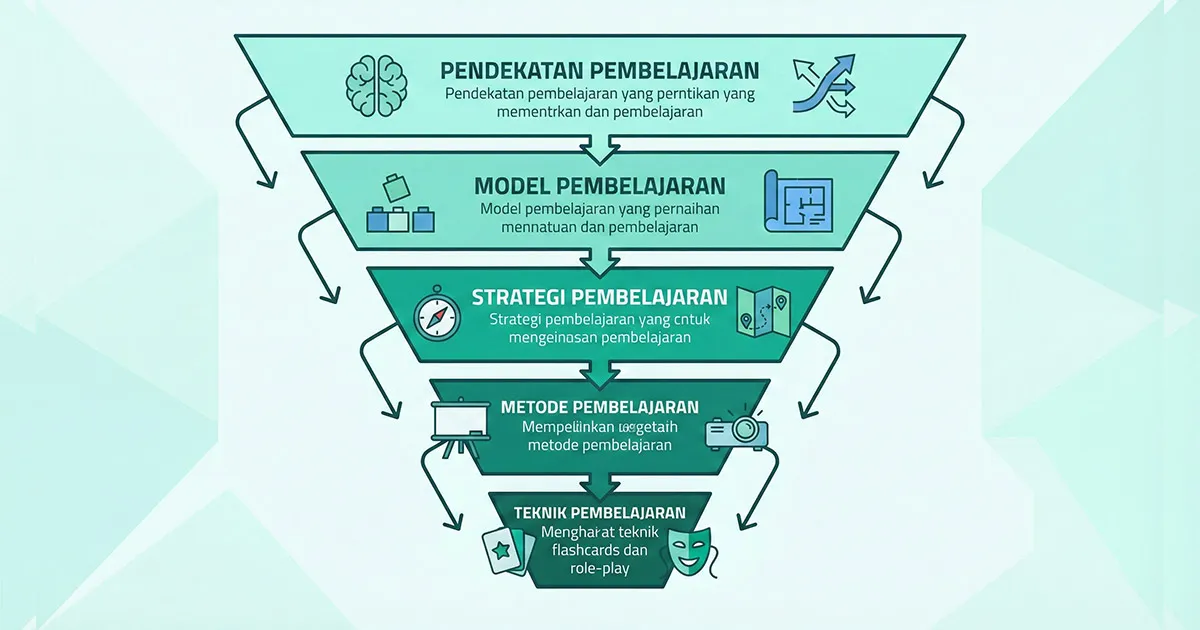
Before we dissect the position of accelerated learning, we must align our perception regarding the hierarchy of learning planning. According to educational experts, the order from the broadest to the most specific is as follows:
- Approach: The starting point or philosophical viewpoint regarding the learning process. (Example: Student-centered or Teacher-centered).
- Learning Model: A conceptual framework that describes systematic procedures in organizing learning experiences. A model is the "wrapper" for approaches, methods, and techniques.
- Learning Strategy: A plan of action (series of activities) designed to achieve specific educational goals.
- Learning Method: Practical ways or procedures used to implement strategies in the classroom. (Example: Discussion, lecture, Q&A).
- Learning Technique/Tactic: A person's specific style in executing a certain method.
So, where does accelerated learning fit into this hierarchy?
Accelerated Learning as an Approach
At its most fundamental essence, Accelerated Learning is a Learning Approach.
Why is it called an approach? Because accelerated learning provides a philosophy, viewpoint, and foundational principles on how humans should learn. This approach views that learning should be natural, involve all five senses (multisensory), be free from stress, and be compatible with how the brain works (brain-friendly).
As an approach, it does not bind you to specific rigid steps. It acts as a "large umbrella" covering various psychological and neurological principles. Teachers using this approach will always ensure their class is enjoyable, students are actively engaged, and material is presented according to student learning styles (Visual, Auditory, Kinesthetic).
Accelerated Learning as a Learning Model
Although strictly philosophical as an approach, in its development, experts have systematized accelerated learning into concrete frameworks. When these principles are arranged into syntax (sequential phases) that are standard in the classroom, its position shifts to become a Learning Model.
One prominent figure who successfully formulated accelerated learning into a structured learning model is Colin Rose. He created an accelerated learning-based learning model known by the acronym MASTER:
- Motivating Your Mind: Building the mood and a relaxed state.
- Acquiring the Information: Absorbing material through various senses.
- Searching Out the Meaning: Exploring material with games or mind mapping.
- Triggering the Memory: Storing information into long-term memory.
- Exhibiting What You Know: Testing understanding, for example through role-play or presentation.
- Reflecting on How You've Learned: Reflecting on what went well and what needs improvement.
In addition to MASTER, another expert named Dave Meier formulated the SAVI model (Somatic, Auditory, Visual, Intellectual) as a form of accelerated learning implementation in the classroom. When you use this MASTER or SAVI syntax in your Lesson Plans, you are using accelerated learning as a learning model.
Why Accelerated Learning is Not Just a Method
Many people mistakenly call it the "Accelerated Learning Method." Given that the definition of a method is a practical and specific way (such as discussion, lecture, or practicum), accelerated learning is too broad to be reduced to merely a method.
Instead of being a method, accelerated learning uses various methods and techniques to achieve its goals.
For example, if you apply the accelerated learning approach, you would choose:
- Methods: Group discussion, project-based, or simulation (not passive hours-long lectures).
- Techniques: Using Baroque music for relaxation, creating Mind Maps for note-taking, or using Chunking (breaking down material).
Thus, Mind Mapping or Chunking are the techniques, whereas Accelerated Learning is the umbrella approach that covers them.
Limitless Flexibility in Modern Curricula
Understanding this position is crucial, especially for teachers implementing modern curricula. Because its primary status is an "approach," accelerated learning is highly flexible to be combined with other learning models.
You can use Project-Based Learning (PBL) but deliver it with an Accelerated Learning Approach (ensuring the project is multisensory, accompanied by relaxation music, and uses memory techniques). This makes it a formidable tool in the hands of creative educators.
Conclusion
To clear up existing confusion, the position of accelerated learning can be summarized into two main points depending on how it is used:
- Fundamentally, it is a Learning Approach grounded in brain-friendly philosophy and multisensory engagement.
- It can function as a Learning Model if you apply structured syntax or steps from experts, such as the MASTER framework from Colin Rose or SAVI from Dave Meier.
It is not a single method, but a comprehensive system that utilizes various methods (discussion, role-play) and techniques (mind maps, mnemonics, music) to accelerate the information absorption process.
FAQ (Frequently Asked Questions)
- 1. So, is it acceptable to call it the "Accelerated Learning Method"? Academically, calling it a "method" is inaccurate because the meaning is too narrow. It is far more accurate to call it an "Approach" or a learning "System."
- **2. What is the difference between the Accelerated Learning Approach and the SAVI Learning Model?**Accelerated learning is the philosophy or the grand approach, whereas SAVI (Somatic, Auditory, Visual, Intellectual) is one concrete "Learning Model" created by Dave Meier to practice that accelerated learning philosophy in the classroom.
- 3. Can Accelerated Learning be combined with the Problem-Based Learning (PBL) Model? Absolutely! You use PBL as the framework (presenting problems, group discussions, presenting solutions), and you use the accelerated learning approach to ensure the PBL process is conducted without stress, uses rich visual aids, and concludes with relaxation.
- 4. If I only use mind mapping in class, have I applied accelerated learning? Not fully. Mind mapping is just one "technique." If you use mind mapping but the classroom atmosphere is full of pressure, students are fearful, and the teacher teaches authoritatively, then you have not applied the essence of the accelerated learning approach.
- 5. Why is it important for teachers to distinguish between the terms approach, model, and method? Distinguishing these terms helps teachers when drafting Lesson Plans or Teaching Modules to be more systematic. Teachers become aware that they must determine the grand approach first, select the syntax model, and then determine the daily execution methods and techniques in class so that learning objectives are optimally achieved.
Share
The History of Accelerated Learning: Origins & Development
Learn the complete history of accelerated learning, from the discovery of Suggestopedia by Dr. Georgi Lozanov in the 1960s to its development in the modern era.
5 Ways to Implement Accelerated Learning in the Merdeka Curriculum
Discover effective ways to implement accelerated learning in the Merdeka Curriculum. Boost student potential with fun learning strategies. Read the guide here!