The History of TTF & OTF Fonts: 5 Crucial Typography Evolutions
Understanding the Importance of TTF and OTF Font History in the Digital Age
Have you ever wondered how the text on your computer or mobile screen can look so neat and sharp? The answer lies in the history of TTF and OTF fonts. These two digital font file formats are the main foundation of all the text we read in the digital world today. Without their presence, modern graphic design and digital typing would never be as comfortable as they are now.
As a computer user, designer, or even a lay writer, understanding the differences and origins of the TrueType Font (TTF) and OpenType Font (OTF) formats is highly important. This knowledge is not just theory, but it also helps you choose the most appropriate format for your printing and on-screen display needs.
In this article, we will travel through a time machine. We will see how fierce competition between giant technology companies gave birth to the typographical innovations we use every day. Let's begin this historical journey.

The Dark Age of Typography: The Era Before TTF and OTF
Before we dive into the history of TTF and OTF fonts, we must look at the state of typography in the 1980s. At that time, computers used what were known as bitmap fonts (pixel-based fonts). These letters were composed of tiny squares arranged in a specific way.
The main problem with bitmap fonts was resolution. If you scaled up the font size, the shapes would break, become jagged, and be very uncomfortable to read. Each font size required a separate file, which severely drained computer storage space at the time.
Adobe's Dominance with PostScript Technology
Recognizing the flaws of bitmaps, Adobe sparked a revolution by introducing the PostScript (Type 1) format. This was an outline font technology, where letters were no longer drawn with pixels, but with mathematical formulas (vectors).
The results were astonishing. Letters could be enlarged to any size without losing their sharpness. However, Adobe monopolized this technology. They charged incredibly high licensing fees to anyone who wanted to use PostScript font technology on their operating systems or printers.
The Birth of TrueType Font (TTF) from a Rivalry
Adobe's monopoly made other tech companies uneasy, especially Apple. Apple needed high-quality fonts for their Macintosh computers but did not want to pay exorbitant licensing fees to Adobe. This is what triggered a new chapter in the history of TTF and OTF fonts.
In the late 1980s, Apple decided to create their own outline font standard. They worked in secret to develop a system that could compete with the sharpness of Adobe PostScript, yet be easier for standard computer screens to process.
Apple and Microsoft Form an Alliance
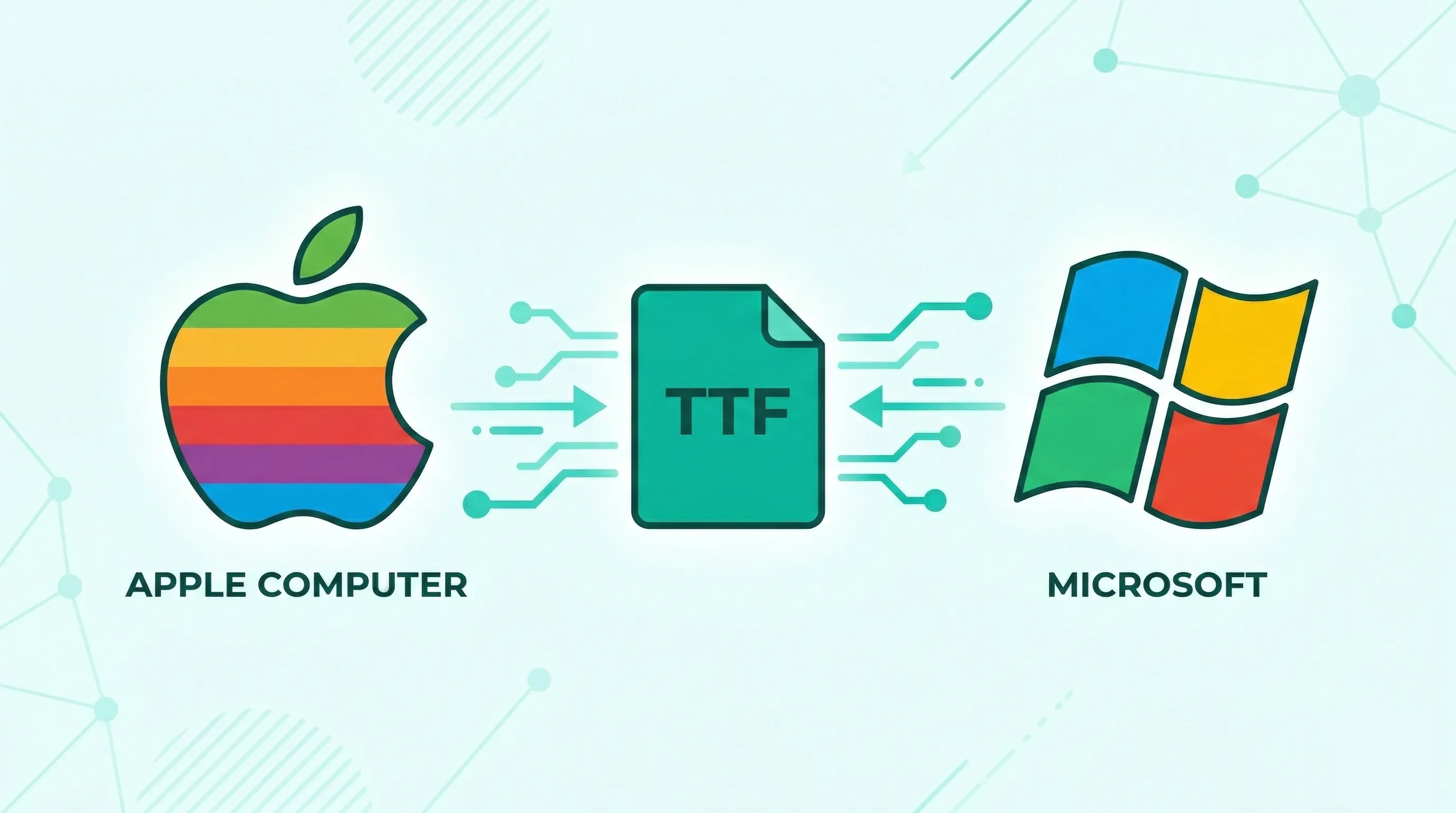
In a surprising business move, Apple teamed up with its main competitor, Microsoft. Apple agreed to license their new font technology to Microsoft for free. In return, Microsoft provided printer technology to Apple.
This collaboration gave birth to the TrueType Font (TTF) in 1991. Apple integrated it into Mac OS, while Microsoft included it in Windows 3.1. This move was a massive success and instantly shattered Adobe's monopoly overnight.
Why Did TTF Become So Popular?
The TTF format exploded in the market due to several key reasons that greatly benefited everyday users:
- Free and Open: Independent font creators could make fonts without having to pay royalties to Adobe.
- One File for All: You only needed one file with the
.ttfextension for both computer screen displays and printing needs. - Perfect Screen Quality: TTF uses highly efficient mathematical calculation technology (quadratic Bézier curves), making letters look incredibly sharp even on low-resolution monitors.
The Evolution Towards OpenType Font (OTF)
The history of TTF and OTF fonts did not stop in the TrueType era. Entering the mid-1990s, digital typography faced new challenges. Professional designers began demanding more advanced features, such as alternate characters, ligatures (connected letters), and support for foreign languages with complex alphabets (like Arabic or Kanji).
Although TTF was excellent for general users, the format had limited space to accommodate thousands of these special characters. The design industry needed something more powerful.
Enemies Become Friends: The Unification of Adobe and Microsoft
Seeing these limitations, Microsoft and Adobe decided to put aside their old rivalry. In 1996, these two tech giants announced a revolutionary new format: OpenType Font (OTF).
OpenType was actually built on the fundamental framework of TrueType. However, Adobe injected data structures from their PostScript technology into it. The result was a "hybrid" format that combined the screen sharpness advantages of Apple/Microsoft with the professional printing prowess of Adobe.
Special Features That Make OTF Superior
This format with the .otf extension immediately became the new standard for professional graphic designers. Here are some of the technical marvels of OpenType:
- Massive Character Capacity: While older fonts could only hold about 256 characters, a single OTF file can accommodate up to 65,000 characters.
- Advanced Typography Features: OTF supports Small Caps, automatic fractions, and swash letter styles (letters with decorative flourishes) in a single file.
- Perfect Cross-Platform Compatibility: OTF files work identically and seamlessly on both Windows and Mac OS without any need for conversion.
3 Main Differences Between TTF and OTF
After learning the history of TTF and OTF fonts, you might be confused about which one to install. Visually, they look the same. However, there are technical differences behind the scenes:
- Letter Construction Curve Structure: TTF uses simpler mathematics (quadratic Bézier), making the file lighter and faster to process by standard computers. OTF uses more complex mathematics (cubic Bézier), providing more precise design freedom for type designers.
- File Size and Capacity: Because OTF can hold tens of thousands of extra characters and letter variations, OTF file sizes are usually slightly larger than TTF.
- Extra Character Usage: If you are typing in standard Microsoft Word, TTF is more than enough. However, if you are designing a luxurious logo in Adobe Illustrator, OTF allows you to pull out aesthetically pleasing letter curve variations.
[Image Instruction 4] > Placement: Right before the conclusion.
--- Unknown node: hardBreak ---
Visual: A screenshot of design software (like Adobe Illustrator) showing active "Ligatures" or "Swash" features using an OTF font.
--- Unknown node: hardBreak ---
Alt Text: An example of using advanced typography ligature features on OpenType fonts in graphic design software. (104 characters)
Conclusion: Which Format Should You Choose?
The history of TTF and OTF fonts proves that technological innovation is born from competition and collaboration. Both are incredible formats and are still in use to this day.
As a practical guide: Choose TTF if you only need fonts for regular document typing, school assignments, or PowerPoint presentations. Besides being lightweight, TTF is 100% compatible with all computers.
Conversely, choose OTF if you are a graphic designer, UI/UX designer, or book layout artist. The extra features within OTF will greatly help you create visual works that are much more professional and aesthetically rich.
FAQ About the History of TTF and OTF Fonts
1. Does the history of TTF and OTF fonts mean other fonts are no longer used?
Not entirely. Although TTF and OTF dominate, there is now a newer format called Web Open Font Format (WOFF) that is specifically optimized for website loading speeds on the internet.
2. Can I install TTF and OTF fonts simultaneously?
Yes, you can install both .ttf and .otf files simultaneously on your Windows or Mac operating system without any system conflicts.
3. Which is older, TTF or OTF?
TrueType Font (TTF) is older. TTF was first released in 1991 by Apple, whereas OpenType Font (OTF) was released in 1996 as a result of a collaboration between Microsoft and Adobe.
4. Why do logo designers prefer the OTF format?
Designers love OTF because this format stores advanced typographical features like ligatures (merging two letters into one beautiful shape) and alternates (different letter style options) that make logos look unique.
5. How do I convert a TTF file to OTF or vice versa?
You can use font creation applications (like FontForge or Glyphs) or use free online font conversion services. However, converting a TTF to OTF will not automatically add advanced design features if the original creator did not include them.
Share